Volkstrauertag at the Neue Wache: Four Regimes, an Open Oculus, and Käthe Kollwitz's Autumn Pietà
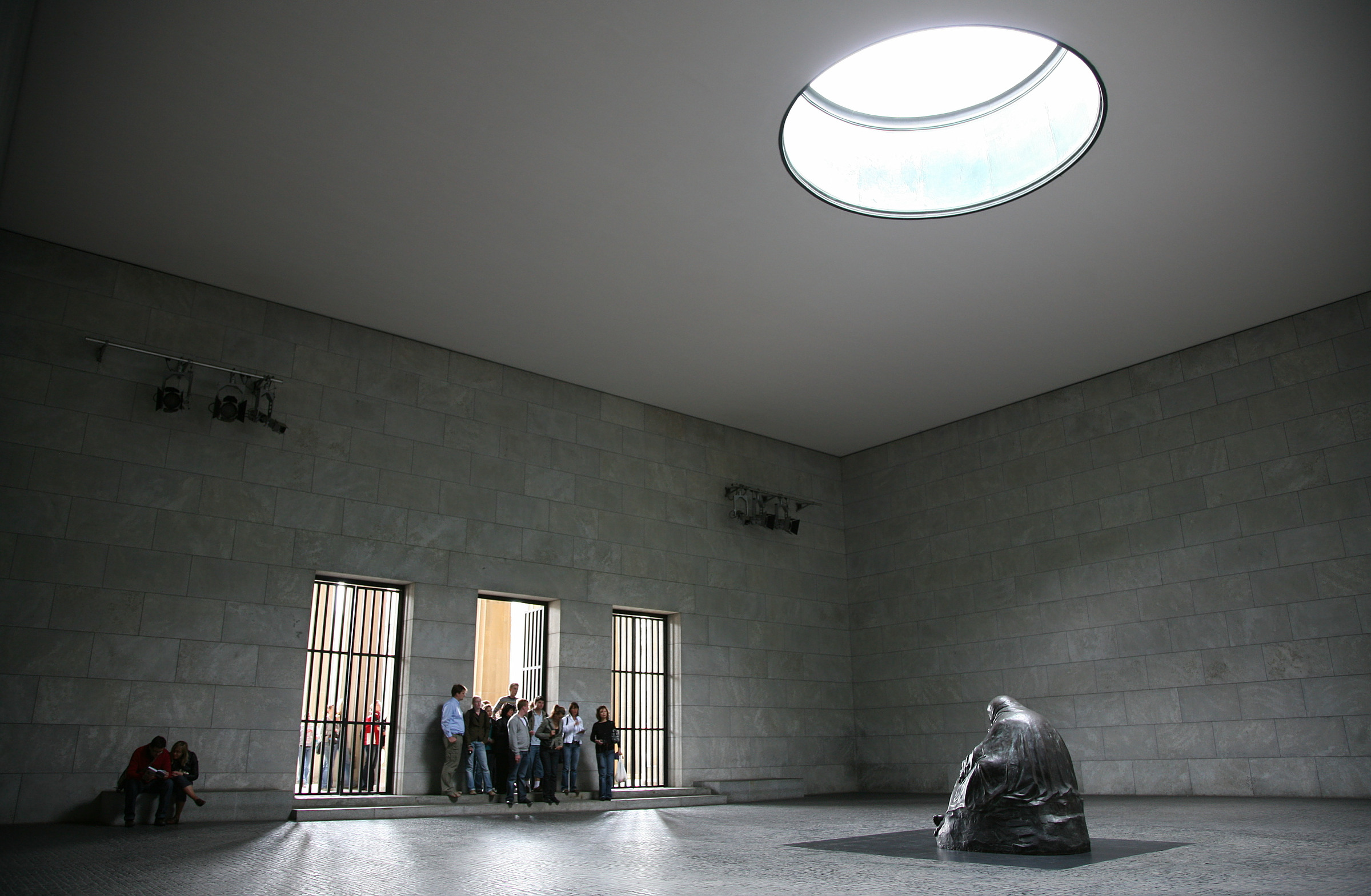
Every November, Berlin's calendar turns inward. Less than a week after November 9—Germany's Schicksalstag ("Day of Fate"), uniting the anniversaries of the 1918 Republic, the 1938 November Pogroms, and the 1989 fall of the Berlin Wall—the city gathers in quiet gray morning air for Volkstrauertag, Germany's National Day of Mourning, falling this year on Sunday, November 15, 2026. On this morning, while wreaths are laid at war graves and civic memorials across the capital, the diplomatic corps, Bundesrat, and Federal President converge on a deceptively small Doric temple on Unter den Linden: Karl Friedrich Schinkel's Neue Wache.
From the boulevard sidewalk, the Neue Wache looks calm, symmetrical, and almost modest beside the towering baroque bulk of the Zeughaus next door. Step past the iron gates into its single windowless stone chamber, however, and you are standing inside one of the most politically contested 400 square meters in Europe—a building that has been stripped, gutted, and ideologically rebuilt by four consecutive German regimes over two centuries.
1816–1818: Schinkel's Prussian Guardhouse on Unter den Linden
Fresh off the defeat of Napoleon, King Frederick William III of Prussia commissioned royal architect Karl Friedrich Schinkel in 1816 to replace an aging artillery guardhouse opposite the Crown Prince's Palace. Completed in 1818, the Neue Wache ("New Guardhouse") became Schinkel's first major monumental work in Berlin and the blueprint for his crisp, severe neoclassical style.
Drawing on the geometry of a fortified Roman castrum, Schinkel anchored four corner pylons around a square sandstone block and fronted the avenue with a six-column Doric portico crowned by a relief of the Goddess of Victory. Unlike ornate Wilhelmine monuments built later in the century, Schinkel deliberately kept the guardhouse restrained—part working military watch station for the royal palace, part civic memorial to Prussian soldiers killed in the 1813–1815 Wars of Liberation.
1931: Heinrich Tessenow and the Open Sky
After the collapse of the German Empire in the November Revolution of 1918, the young Weimar Republic faced an awkward question: what do you do with a royal guardhouse that no longer has a king to guard? In 1931, Prussian authorities commissioned architect Heinrich Tessenow to convert the building into an Ehrenmal—a memorial for the German dead of World War I.
Tessenow's solution was radical minimalism. He gutted the interior entirely, clad the tall walls in pale ashlar stone, and cut a circular oculus straight through the ceiling—leaving the center of the room permanently open to Berlin rain, November wind, and falling chestnut leaves. Beneath that shaft of northern light, he placed a single slab of black granite topped with a silver-and-gold oak wreath. There were no heroic statues, no triumphant inscriptions—only cold stone and changing weather.
1960–1990: The GDR's Eternal Flame and Goose-Stepping Guard
Bombed and burned during the Battle of Berlin in 1945, the Neue Wache landed inside the Soviet sector along East Berlin's showcase boulevard, just down the street from the divided rail corridor explored in our Tränenpalast Cold War guide and the buried history of Anhalter Bahnhof. Restored externally in 1957–1960, the East German government rededicated the hall in 1960 as the Memorial to the Victims of Fascism and Militarism.
For the GDR's 20th anniversary in 1969, architect Lothar Kwasnitza sealed off Tessenow's austere simplicity by installing a dramatic central glass prism housing an eternal flame, flanked by embedded bronze plaques and the buried remains of an unknown German soldier and an unknown concentration camp prisoner, alongside urns of earth from battlefields and Nazi camps. Outside under Schinkel's Doric portico, soldiers of the Friedrich Engels Guard Regiment of the National People's Army stood stiffly at attention in pairs, performing high-stepping guard changes that drew curious crowds of West Berlin day-trippers and foreign visitors until 1990.
1993: Käthe Kollwitz's Pietà Beneath the Rain
Following reunification, Chancellor Helmut Kohl's government sought a single national site for Germany's Erinnerungskultur—removing the GDR's eternal flame, marble plaques, and goose-stepping sentries, and returning the hall to Tessenow's stark 1931 stone proportions. On Volkstrauertag, November 14, 1993, the Neue Wache reopened as the Central Memorial of the Federal Republic of Germany for the Victims of War and Tyranny.
At the dead center beneath Tessenow's open oculus sits a fourfold enlargement—roughly 1.6 meters tall—cast by sculptor Harald Haacke from Käthe Kollwitz's 1937–1938 bronze sculpture Mutter mit totem Sohn ("Mother with Her Dead Son"). For Kollwitz, grief was not an architectural abstraction: her 18-year-old younger son, Peter Kollwitz, had volunteered at the outbreak of World War I and was killed in Flanders in October 1914. For more than two decades she worked through that loss in charcoal, woodcut, and bronze, sculpting a mother hunched forward cradling her dead child across her knees.
Because the roof oculus remains unglazed, November rain runs down the bronze shoulders and pools across the stone floor while dead leaves drift in off Unter den Linden. The choice sparked fierce public debate in 1993—critics argued that a Christian-echoing Pietà risked blurring soldiers and Holocaust victims together—leading officials to mount two explanatory bronze plaques beside the entrance explicitly naming every murdered and persecuted group alongside fallen soldiers and civilian dead.
Visit the Neue Wache on a damp late-afternoon weekday in November just before dusk, when tour buses have cleared out and rainwater catches the bronze folds under the oculus. Then pair it with the original, intimate 38-centimeter cast of Kollwitz's Pietà at the Käthe Kollwitz Museum Berlin—which permanently relocated in September 2022 from its longtime Fasanenstraße townhouse to the historic Theaterbau at Schloss Charlottenburg (Spandauer Damm 10)—or walk up to Kollwitzplatz in Prenzlauer Berg, where she lived and worked for nearly fifty years.
Visitor Logistics & Planning Your Visit
Neue Wache: Unter den Linden 4, 10117 Berlin (Mitte), directly between the Zeughaus (German Historical Museum) and Humboldt University. Hours: Open daily from 10:00 AM to 6:00 PM (note that public access pauses briefly during official state ceremonies on Volkstrauertag morning before reopening later in the day). Admission: Free. Public Transit: Take U-Bahn U5 to Museumsinsel (3-minute walk) or S-Bahn/Regional trains to S+U Friedrichstraße or S Hackescher Markt; Bus lines 100 and 300 stop directly along Unter den Linden at Staatsoper / Lustgarten. View on Google Maps.


Comments
Post a Comment