The Phantom Terminus: Anhalter Bahnhof’s Lonely Brick Portal and the Ghosts of Pre-War Rail Travel
Stand in the open turf of Askanischer Platz on an overcast morning in Kreuzberg, and the monumental brick arch rising against the sky looks almost like a Roman triumphal gateway dropped into central Berlin by mistake. Weathered yellow-and-red clinker brick, deep Renaissance arches, and chipped terracotta friezes stand completely detached from any building, framing nothing but green grass, swaying trees, and the distant hum of city traffic.
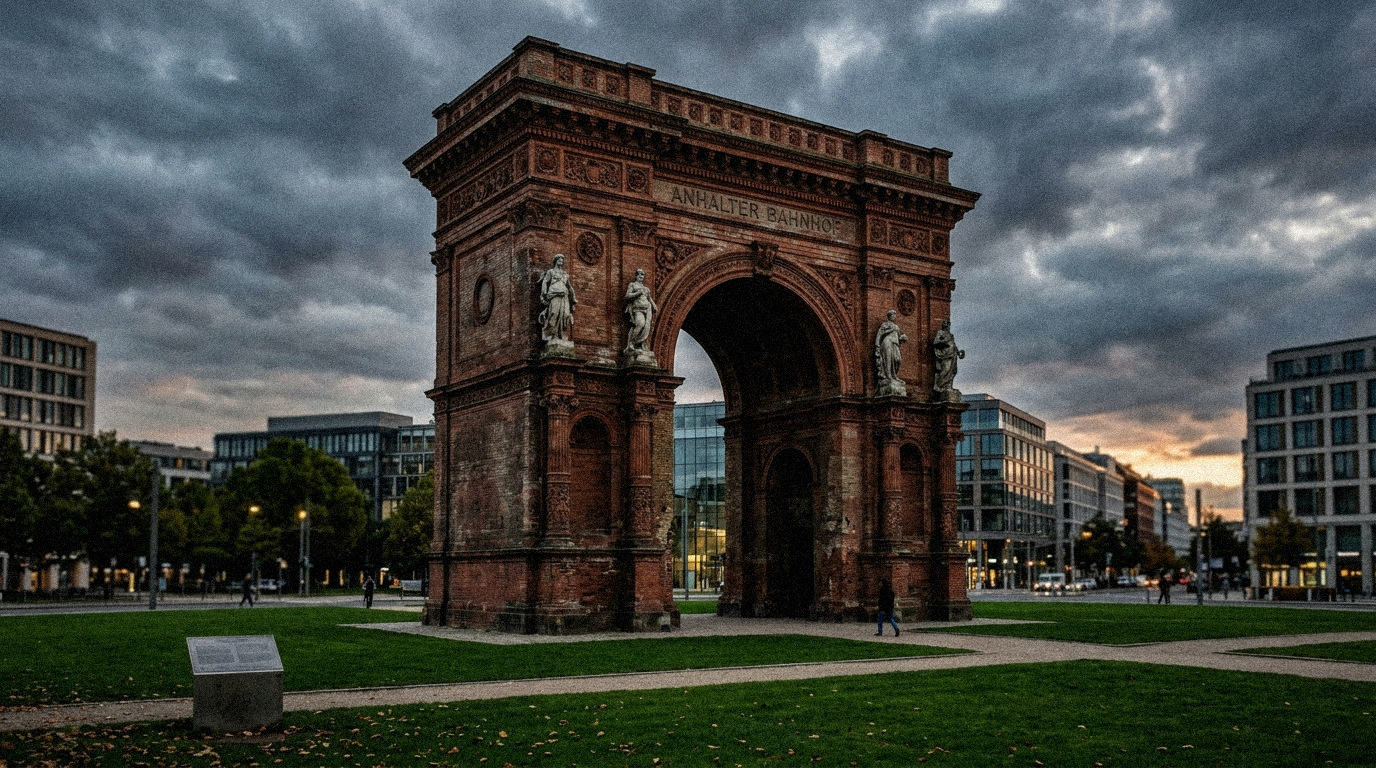
This solitary brick fragment is the Portikus of Anhalter Bahnhof. A century ago, this was the epicenter of continental European travel—the legendary "Gateway to the South." From beneath an unprecedented 62-meter clear-span iron vault, luxury express trains departed daily for Munich, Vienna, Rome, Cannes, and Athens. What brought this imperial palace of steam and steel to its knees is not just the bombs of World War II, but an even more tragic chapter of Cold War politics, bureaucratic neglect, and one of the most controversial demolition orders in modern urban history.
Franz Schwechten and the Imperial Cathedral of Steam
By the 1870s, Berlin was transforming into the industrial, political, and cultural capital of the newly unified German Empire. The original 1841 terminus of the Berlin-Anhalt Railway Company could no longer handle the massive volume of traffic pouring into the metropolis. In 1874, the company commissioned architect Franz Schwechten—later celebrated for designing Charlottenburg's Kaiser Wilhelm Memorial Church—to conceive an epochal station.
When Anhalter Bahnhof opened in June 1880 in the presence of Emperor Wilhelm I and Chancellor Otto von Bismarck, it stunned Europe. Schwechten designed the terminus in an opulent Northern Italian Neo-Renaissance style, executing the facades in rich buff-colored clinker brick embellished with terracotta moldings, Corinthian capitals, and allegorical reliefs.
Behind the palatial facade lay a marvel of 19th-century structural engineering: a grand train shed designed by Heinrich Seidel. Spanning 62 meters across without intermediate columns and rising 34 meters high, the glass-and-iron barrel vault was the largest free-spanning railway shed on the European continent. Crowning the central clock tower above Askanischer Platz were Ludwig Brunow's allegorical zinc figures of Day (holding a torch) and Night (holding a sleepy owl), gazing down on kings, diplomats, and international celebrities like Charlie Chaplin and Marlene Dietrich as they stepped into Berlin.
The Gathering Darkness: Exile and Wartime Deportations
During the Weimar Republic, Anhalter Bahnhof was the pulse of the metropolis. But with the Nazi seizure of power in 1933, the station’s role reversed from a gateway of glamour into a threshold of heartbreak.
Between 1933 and 1939, as totalitarian terror engulfed Germany, tens of thousands of Jewish citizens, artists, scientists, and political dissidents bought one-way tickets out of Anhalter Bahnhof. For luminaries like Thomas Mann, Heinrich Mann, and thousands of nameless families fleeing into foreign exile, the station's Neo-Renaissance portals were the very last glimpse of their homeland.
Later, the station became an instrument of unspeakable horror. Between June 1942 and March 1944, the Nazi regime used Anhalter Bahnhof as a clandestine deportation hub. In the dead of night, away from the public gaze, the Gestapo forced over 9,600 elderly German Jews onto regular passenger cars at the station's lower-level postal and parcel tracks, dispatching them to the Theresienstadt concentration camp.
The 1945 Air Raids and the Tragic 1959 Demolition Blunder
During the devastating Allied air raids of February 3, 1945, Anhalter Bahnhof took direct hits from high-explosive bombs. The magnificent glass-and-iron train shed buckled and burned, leaving a blackened steel skeleton, while the sturdy brick headhouse and facade remained largely standing.
Following the 1945 partition, Anhalter Bahnhof found itself trapped in a bizarre geopolitical anomaly. The station structure was situated in the American sector of West Berlin, but the railway tracks, yards, and signals belonged to the Deutsche Reichsbahn, which was operated exclusively by the Soviet-controlled East German authorities. As Cold War tensions hardened, the East German government refused to operate trains into West Berlin terminals. They diverted long-distance rail corridors around the perimeter of West Berlin and into East Berlin’s Ostbahnhof. On May 18, 1952, East Germany abruptly terminated all train operations at Anhalter Bahnhof, padlocking the terminal forever.
For the next seven years, the massive ruin stood silent—an eerie, romantic silhouette on the Kreuzberg skyline. Structural engineers concluded that while the roof was gone, the monumental brick walls and entrance halls were completely sound and could be restored or repurposed into a concert hall or sporting arena. Yet in 1959, in an act of aggressive post-war modernization, the West Berlin Senate decreed its total demolition.
Outraged architects, historians, and citizens launched fierce demonstrations. While they could not stop the wrecking crews from dynamiting the magnificent side halls and clearing the immense parcel tracks, their protests successfully halted the demolition of the central entrance portal. When the dust settled in 1960, only the lonely central Portikus remained standing—saved at the eleventh hour as an open-air scar on the urban fabric.
Inspect the surviving Portikus carefully up close. Directly beneath the central arch, look down into the ground to find the bronze memorial plaque documenting the deportation of Berlin’s Jewish citizens to Theresienstadt. Then walk just 150 meters northwest along Schöneberger Straße to discover the massive Anhalter Hochbunker—a gargantuan five-story, six-foot-thick concrete air raid bunker built in 1942 that sheltered up to 12,000 rail passengers during wartime air raids.
The Rebirth: Portikus Memorial and the Future Exilmuseum
Today, the site of Anhalter Bahnhof is on the cusp of an extraordinary cultural renaissance. The open fields behind the Portikus—where passenger tracks once stretched south toward the Landwehr Canal—now form an urban park and sports grounds, while underground S-Bahn lines (S1, S2, S25, S26) still stop beneath the historic square.
Directly behind the surviving Portikus, construction is underway for the **Stiftung Exilmuseum Berlin** (Berlin Exile Museum). Designed by acclaimed Danish architect Dorte Mandrup following an international competition, the museum features an elegant, curved masonry facade that bows respectfully behind the historic 1880 portal without touching it. The permanent institution will honor the more than 500,000 individuals forced into exile under Nazi tyranny, anchoring their stories to the very platform from which so many departed forever.
Location & Visitor Logistics
Visiting Anhalter Bahnhof (Portikus Memorial)
- Location: Askanischer Platz, 10963 Berlin-Kreuzberg.
- Transit: S-Bahn station Anhalter Bahnhof (Lines S1, S2, S25, S26). Take the Askanischer Platz exit to emerge directly beside the ruin. Also served by Bus M41.
- Hours: Open public memorial square, accessible 24/7.
- Admission: Free.
- Nearby Highlights: The German Museum of Technology (Deutsches Technikmuseum) is located just 10 minutes south along Trebbiner Straße, where the original Brunow statues of Day and Night from Anhalter Bahnhof's clock tower are preserved in the railway roundhouse.


Comments
Post a Comment