Inside the Stasi Headquarters: Erich Mielke's Preserved Office, the Architecture of Paranoia, and Haus 1 at Normannenstraße
Turn off the bustling Frankfurter Allee in Berlin's eastern district of Lichtenberg onto Ruschestraße, and the urban energy of modern Berlin suddenly drops away. Before you rises an immense, forbidding fortress of weathered prefabricated concrete and grey plaster: a sprawling 50-building administrative complex spanning an entire city block. Between 1950 and 1990, this top-secret garrison was completely erased from official East German street maps. It was the nerve center of the Ministry for State Security (Ministerium für Staatssicherheit)—better known to history by its chilling acronym: the Stasi.
At its peak, this sprawling compound employed more than 7,000 full-time intelligence officers, surveillance technicians, interrogators, and archival clerks. From behind these double-glazed acoustic windows, the Stasi orchestrated an omnipresent domestic surveillance apparatus that maintained detailed operational dossiers on more than one-third of the East German populace, aided by an estimated network of 173,000 “unofficial collaborators” (Inoffizielle Mitarbeiter or IMs). Today, the heart of the complex—the ministerial headquarters building designated Haus 1—stands preserved as the Stasimuseum, offering an unparalleled look into the architecture of totalitarian surveillance.
Erich Mielke and the Bureaucracy of Paranoia
The ministry was shaped in the image of its long-serving minister, Erich Mielke, who held autocratic control over the apparatus from 1957 until the collapse of the regime in November 1989. Mielke, an unrepentant Stalinist who viewed all dissent as foreign sabotage, coined the ministry's chilling operational motto: “Schild und Schwert der Partei” (“Shield and Sword of the Party”).
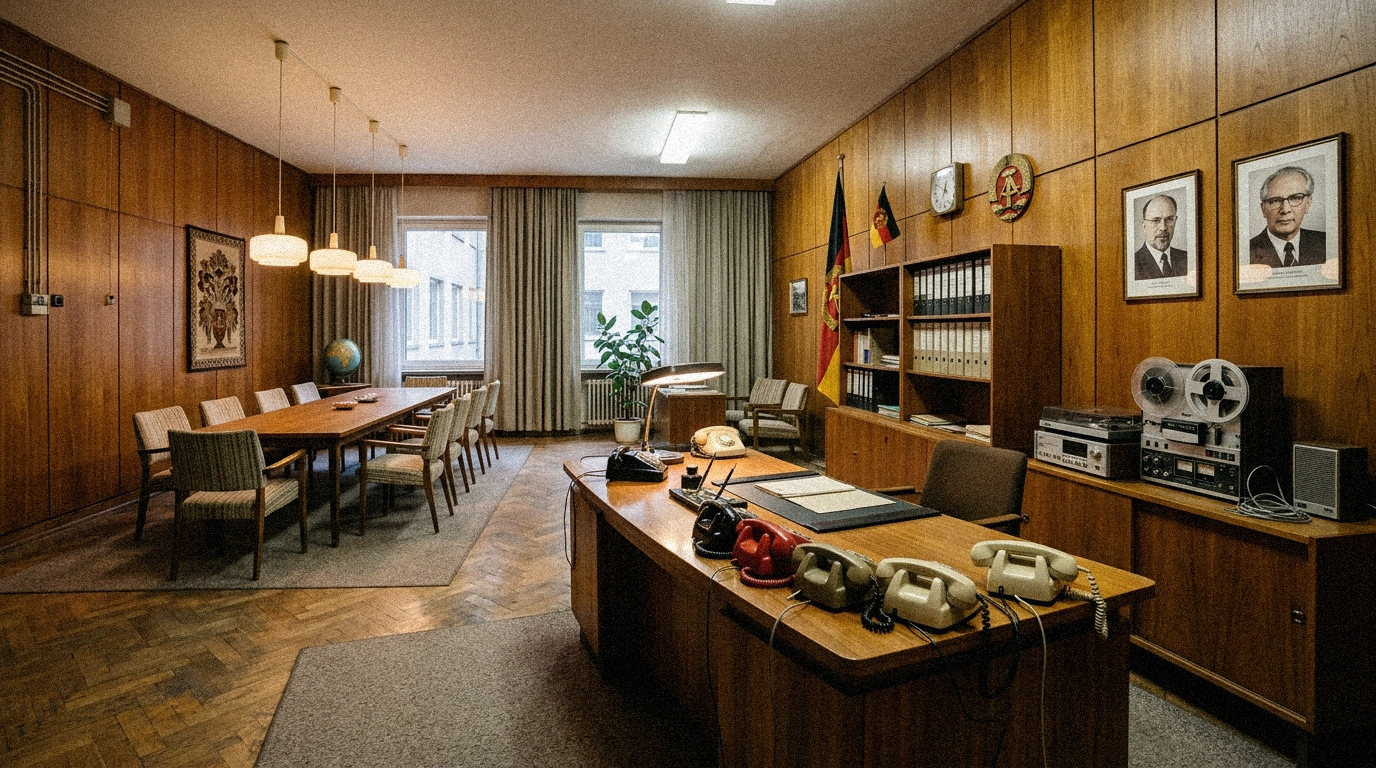
Constructed in 1960–1962, Haus 1 was engineered to convey socialist executive prestige while maintaining airtight security. Ascending to the second floor, visitors step directly into Mielke’s executive suite, preserved in its eerie, untouched state. The suite comprises Mielke’s private workspace, an expansive wood-paneled conference room, a radio communications dispatch room, a secure secretary anteroom, and a private bedroom for overnight shifts during geopolitical crises.
The interior design is a masterclass in Cold War socialist modernism: herringbone parquet flooring, textured beige wall fabrics, heavy dark teak veneers, and brass light fixtures. Upon Mielke's massive executive desk sits a bank of customized, multi-colored rotary telephones—direct, encrypted hotlines connecting him to the GDR Council of Ministers, the Central Committee, the Soviet KGB headquarters in Karlshorst, and the Warsaw Pact command in Moscow.
As you walk through the ground floor lobby of Haus 1, look for the operational wooden Paternoster—a continuously moving open-cabin elevator without doors. While general museum visitors are not permitted to ride it for modern safety regulations, watching this mechanical relic cycle silently through the floor plates provides a vivid sense of the daily routine of Stasi officers in the 1970s.
The Technology of Surveillance: Microdots to Scent Jars
Beyond Mielke's personal offices, Haus 1 houses extensive exhibitions showcasing the physical tools of Cold War espionage developed by the Stasi's Technical Operations Sector (Operativ-Technischer Sektor or OTS):
- Concealed Miniature Cameras: Subminiature 35mm robot cameras disguised inside watering cans, birdhouses, briefcases, hollowed-out tree trunks, and neckties, operated via remote mechanical release cables hidden in coat pockets.
- Acoustic Eavesdropping: High-sensitivity wall-drilling microphones and directional laser microphones capable of bouncing invisible beams off apartment window panes to decode interior speech vibrations from hundreds of meters away.
- Odor Samples (Geruchskonserven): Perhaps the most macabre artifact of Stasi tradecraft: airtight glass apothecary jars containing yellow cotton dust cloths impregnated with the body odor of suspected political dissidents. Interrogators secretly wiped the seat cushions where suspects sat, sealing the cloths into jars so trained tracking hounds could hunt dissidents down if they attempted to flee.
- Steam Desealing Stations: Industrial letter-steaming machines used by Department M (Postal Control) to open, inspect, photograph, and reseal hundreds of thousands of pieces of private mail every day without leaving detectable creases.
January 15, 1990: The Storming of Normannenstraße
The preservation of Haus 1 is nothing short of miraculous. Following the peaceful opening of the Berlin Wall on November 9, 1989, Stasi leadership recognized their days were numbered. Behind closed doors across the complex, officers worked around the clock in Operation “Feuerlöschung” (Fire Extinguishing), feeding millions of classified surveillance files, informant index cards, and interrogation transcripts into commercial paper shredders.
When the shredders overheated and broke down under the massive volume, officers began tearing sensitive documents into paper confetti by hand and stuffing them into burlap sacks for incineration. Realizing the historical record was being destroyed, thousands of peaceful civilian demonstrators gathered outside the gates of Normannenstraße on the evening of January 15, 1990.
In a climactic, bloodless citizen revolt, demonstrators surged through the gates and occupied the complex, physically subduing guards, locking the archive vaults, and confiscating more than 16,000 burlap sacks of torn documents. Citizens immediately formed the non-profit collective ASTAK (Antifaschistischer Arbeitskreis), dedicated to preserving the building as a memorial so that the mechanics of state surveillance would forever remain transparent to future generations.
Visitor Logistics and Museum Access
- Address: Ruschestraße 103 / Haus 1, 10365 Berlin-Lichtenberg.
- Public Transit: Take U-Bahn line U5 to Magdalenenstraße station (exit toward Ruschestraße) and walk two minutes north. Alternatively, take the S-Bahn (lines S41/42, S8, S85) to Frankfurter Allee and walk 8 minutes east.
- Hours: Monday through Friday, 10:00 AM – 6:00 PM; Saturday and Sunday, 11:00 AM – 6:00 PM.
- Admission: €10 regular adult admission, €8 reduced/students. Guided tours in English are offered on select weekdays and weekends.
- Audio Guides: Highly recommended multilingual audio guides are available at the front desk for an immersive walkthrough of Mielke's office suite and technical exhibits.


Comments
Post a Comment