Wünsdorf: Exploring the Underground Cold War Bunkers of the 'Forbidden City'
Imperial Roots: From Firing Ranges to Germany's First Mosque
Wünsdorf's military history began in 1910, when the Imperial German Army acquired thousands of acres of sandy pine barren to build firing ranges, barracks, and military sports training facilities. Connected by direct rail lines to Berlin, it quickly grew into the largest garrison of the German Empire.
During World War I, Wünsdorf served a unique and surprising role. The imperial high command established two specialized prisoner-of-war camps here: the Weinberglager and the Halbmondlager (Half Moon Camp). The Half Moon Camp held roughly 4,000 Muslim, Sikh, and Hindu colonial troops captured from British and French armies.
Hoping to incite an anti-colonial jihad against the British and French empires, the German government built Germany’s first functioning wooden mosque on the grounds in July 1915, complete with a 23-meter minaret and dome. While the geopolitical scheme largely failed, the camp remained an extraordinary early chapter in Germany’s intercultural military history before the wooden mosque was dismantled due to decay in 1925.
The Nazi Nerve Center: Bunkers Zeppelin and Maybach (1935–1945)
Following Adolf Hitler's rise to power and the rearmament of the Wehrmacht, Wünsdorf underwent a massive, secret transformation. In 1935, the town was selected as the supreme headquarters of both the Army High Command (OKH) and the Armed Forces High Command (OKW).
To protect the military leadership from anticipated Allied aerial bombardment, engineers from the Postal Ministry and the military constructed two complementary subterranean complexes:
1. Bunker "Zeppelin" (Amt 500)
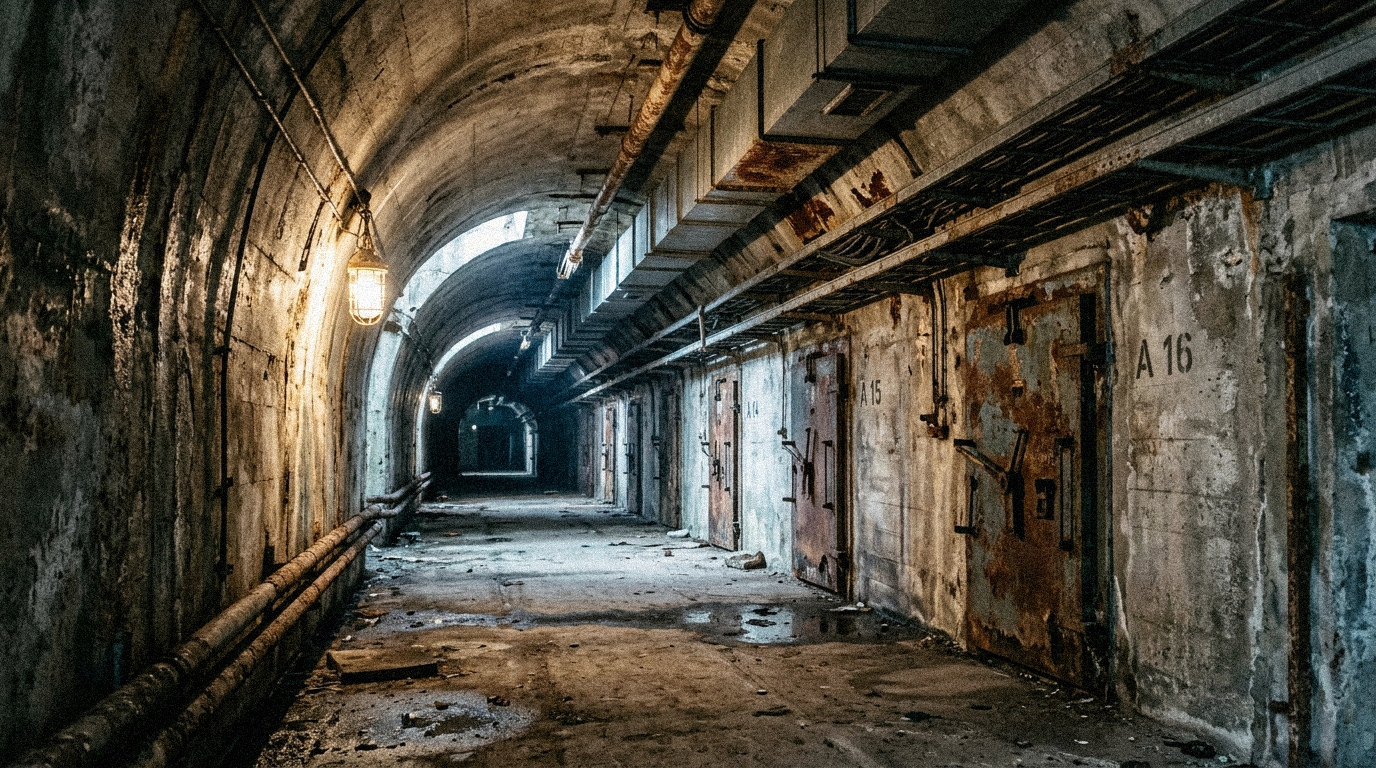
Constructed between 1937 and 1939 under the code name Amt 500, Zeppelin was one of the largest underground telecommunications fortresses ever built. Buried twenty meters below ground, its two-story central chamber measured 117 meters by 22 meters, protected by a ceiling of three-meter-thick reinforced concrete and five meters of soil overburden.
Zeppelin was the central communications exchange of the Third Reich. Every telephone call, teleprinter dispatch, and radio cipher between the Berlin Chancellery and German field armies across Europe, North Africa, and the Eastern Front was routed through its subterranean switchboards. It was here, in June 1941, that the operational orders launching Operation Barbarossa against the Soviet Union were transmitted.
2. The "Maybach" Bunker Complexes
Directly adjacent to Zeppelin sat the Maybach I and II bunker clusters. Designed to house the staff of the General Staff, these above-ground buildings were an ingenious exercise in visual camouflage.
From the air, British and American reconnaissance pilots saw what appeared to be an idyllic German residential suburb: pitched red-tile roofs, painted wooden shutters, dormer windows, and simulated garden fences. In reality, the "houses" were solid concrete bomb shelters with walls up to two meters thick, concealing staircases that plunged deep into interconnected underground tunnels linked directly to Bunker Zeppelin.
The underground bunker tunnels of Wünsdorf can only be visited on official guided tours operated by the Bücherstadt Wünsdorf museum association. The subterranean complex is completely unheated and remains a constant 46°F to 50°F (8°C to 10°C) year-round with high humidity and uneven wet concrete floors. Bring a warm jacket, sturdy water-resistant boots, and a powerful personal flashlight to illuminate the dark blast doors and cable conduits that overhead work lights miss.
The Cold War "Little Moscow": Life in the Forbidden City (1945–1994)
In late April 1945, advancing armored units of Marshal Georgy Zhukov’s 1st Belorussian Front overran Wünsdorf. The German staff had fled hours earlier; Soviet technicians found the telecommunications equipment intact and telex machines still printing messages.
In 1953, Wünsdorf was officially designated the supreme military headquarters of the Group of Soviet Forces in Germany (GSSD)—the spearhead of the Warsaw Pact in Europe.
The Soviet military sealed off 260 square kilometers of territory behind high concrete security walls, guard towers, and security checkpoints. For the next four decades, Wünsdorf was an extraterritorial Soviet enclave. Up to 60,000 Soviet officers, soldiers, and civil personnel lived here in complete isolation from the surrounding East German population:
- A Self-Contained City: The garrison operated its own Russian kindergartens, primary schools, department stores (*Univermag*), bakeries, cinemas, and specialized hospitals. Only Soviet rubles were accepted in shops.
- The Moscow Express: Every day, a dedicated passenger train departed the Wünsdorf station, traveling non-stop across Poland and Belarus directly into Moscow’s Belorussky Station, carrying military dispatches, officers, and families.
- Haus der Offiziere (House of Officers): Built originally as an imperial military sports academy in 1914 and later used by Olympic athletes preparing for the 1936 Berlin Games, the Soviets expanded it into a grand cultural palace featuring an indoor swimming pool, a 1,000-seat theater, and a monumental bronze statue of Vladimir Lenin that still stands on the overgrown lawn today.
The 1994 Withdrawal and the Birth of "Bücherstadt"
Following the fall of the Berlin Wall and the 1990 Two Plus Four Treaty, the newly formed Russian Federation agreed to withdraw all military forces from unified Germany by the end of 1994.
In August 1994, the final Russian troops staged a somber farewell ceremony in Wünsdorf, lowered their flags, and boarded transport trains for the east. They left behind a sprawling, silent city of crumbling barracks, abandoned ammunition bunkers, Cyrillic wall slogans, and peeling propaganda murals depicting Soviet cosmonauts and heroic red soldiers.
In the late 1990s, to prevent the historic garrison from descending into complete decay, local authorities transformed the above-ground district into Bücherstadt Wünsdorf (Book Town Wünsdorf)—the first antiquarian book village in Germany. Today, several former military administrative buildings house antiquarian bookstores, military history museums, and exhibition galleries.
Visitor Logistics & Exploration Details
- Location: Gutenbergstraße 9, 15806 Zossen-Wünsdorf (approx. 45 minutes south of Berlin by regional rail).
- Getting There by Transit: Take the RE8 regional express train directly from Berlin Hauptbahnhof, Potsdamer Platz, or Südkreuz to Wünsdorf-Waldstadt station (approx. 45 minutes). From the station, the Bücherstadt museum office and bunker tour meeting points are a 15-minute walk down Chausseestraße.
- Bunker Tours: The Garnisonsmuseum Wünsdorf offers daily guided walking tours through Bunker Zeppelin and the ruins of Maybach I. Full subterranean tours last roughly 1.5 to 2 hours. Due to safety regulations inside the unlit blast tunnels, solo self-guided entry into the underground complex is strictly prohibited.
- Haus der Offiziere: The historic House of Officers complex is currently secured behind perimeter fencing for safety, but guided photographic walking tours of the exterior grounds, indoor pool, and Lenin statue are offered on designated weekend dates.


Comments
Post a Comment