Bornholmer Straße & The Bösebrücke: The Cold War Checkpoint Where the Berlin Wall Cracked Open
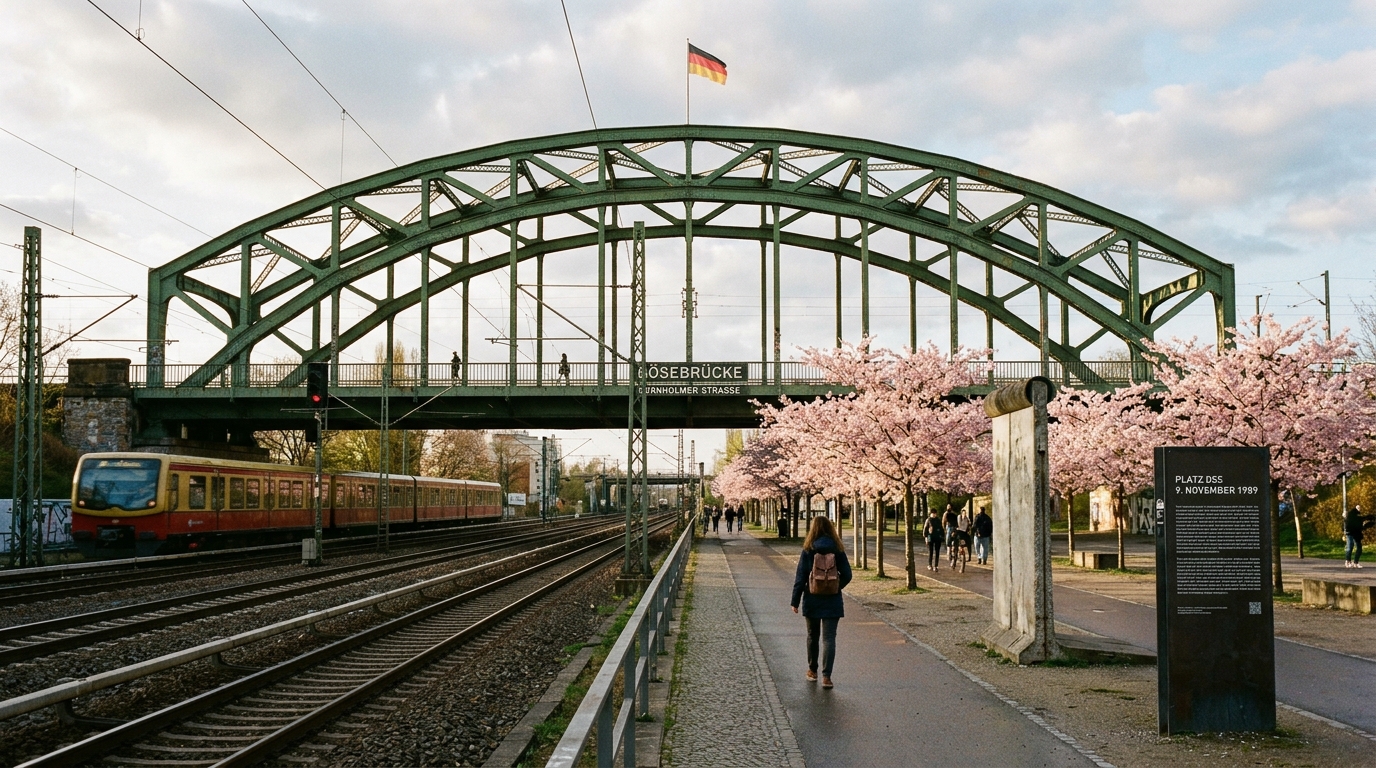
Engineering the Bösebrücke: 1916 Riveted Steel Across the Rails
Long before it became the focal point of the Cold War’s climactic drama, the bridge was celebrated as a triumph of early 20th-century German civil engineering. Constructed between 1912 and 1916 by architect Friedrich Krause and engineer F. Hedde, the structure was originally named the Hindenburgbrücke in honor of Field Marshal Paul von Hindenburg.
The bridge was engineered to solve a major urban transportation bottleneck: spanning a massive 138-meter bundle of north-south railway trunk lines and S-Bahn commuter tracks that severed the booming industrial working-class neighborhood of Wedding from the rapidly growing residential quarters of Prenzlauer Berg. Krause and Hedde designed a monumental, three-hinged riveted steel arch bridge resting on massive granite-faced masonry piers.
In 1948, following World War II and the denazification of Berlin’s street names, the magistrat renamed the bridge the Bösebrücke in honor of Wilhelm Böse, an anti-Nazi communist resistance fighter and member of the Saefkow-Jacob-Bästlein organization who was executed by the Nazi regime in Plötzensee Prison in August 1944.
When the Socialist Unity Party (SED) erected the Berlin Wall on August 13, 1961, the Bösebrücke became one of the most strictly controlled international border crossings in Europe (Grenzübergangsstelle Bornholmer Straße). The bridge was severed by anti-tank barriers, floodlit watchtowers, hydraulic vehicle traps, and enclosed passport inspection booths operated by Department VI of the Ministry for State Security (the Stasi).
Begin your visit at the open-air memorial square on the eastern bridgehead (Platz des 9. November 1989). Embedded in the ground is an engraved stainless-steel timeline chronicling the exact hour-by-hour breakdown of that historic night. Then, take the pedestrian stairs on the southern side of the bridge down to the former railway cutting along Norwegerstraße. This was once the heavily mined "death strip." Today, it is lined with hundreds of Japanese cherry trees. Visit in mid-to-late April during Hanami, when the pink canopy blossoms overhead in stunning contrast against the preserved concrete border slabs.
The Dilemma of Harald Jäger: 11:30 PM at the Barrier Gate
The man standing at the center of the storm on November 9 was 46-year-old Lieutenant Colonel Harald Jäger, the deputy head of passport control at Bornholmer Straße and a loyal 25-year veteran of the Stasi. Jäger had been eating a sandwich in the staff canteen when Schabowski’s press conference aired. Within an hour, crowds began gathering at his checkpoint gates, chanting *"Tor auf! Tor auf!"* (Open the gate!).
By 9:00 PM, more than 20,000 citizens were pressed shoulder-to-shoulder against the checkpoint fences. Jäger frantically dialed his superiors at Stasi headquarters and the Ministry of the Interior, demanding clear directives: Should the guards draw weapons? Were people allowed through?
His commanders refused to take responsibility. One general dismissed Jäger’s reports as hysterical exaggerations; another ordered him to initiate a cynical psychological tactic known as the "letting-off-steam solution" (Ventillösung). Under this scheme, border guards selectively stamped passports of the most vocal protestors with an exit stamp placed directly over their photo—secretly revoking their East German citizenship and exiling them forever without their knowledge.
The ploy backfired catastrophically. As spouses were separated at the gate and word of the trick spread, the fury of the crowd multiplied. By 11:15 PM, the crush of people threatened to collapse the perimeter fences, risking a fatal stampede against armed, terrified young border guards.
Realizing that shooting into an unarmed crowd of thousands would trigger a bloodbath, Harald Jäger made a unilateral, insubordinate decision that defied every military order he had sworn to uphold. Turning to his subordinates, Jäger uttered the historic command: "Wir fluten!" (We flood!).
At 11:30 PM, the guards swung the heavy steel turnstiles and vehicle barriers wide open, abandoning all passport checks. A human tidal wave surged across the Bösebrücke into West Berlin. On the Wedding side of the bridge, thousands of West Berliners stood waiting with champagne, flowers, and open arms, pulling strangers into ecstatic embraces atop cars and bridge railings. The Wall had fallen.
From Death Strip to Sakura Canopies: The Living Memorial Today
Today, the Bösebrücke stands as one of Berlin’s most evocative historical landscapes. Rather than flattening the Cold War architecture into sterile parkland, the city carefully integrated remnants of the border fortifications into the Platz des 9. November 1989.
Visitors walking across the bridge encounter a series of preserved concrete wall slabs, rusted iron structural elements, and glass information steles presenting archival photographs and eyewitness quotes from both sides of the crossing.
Immediately south of the bridge along the former patrol track (Kolonnenweg), history gives way to poetry. In 1990, the Japanese television network TV Asahi organized a nationwide charity campaign in Japan to commemorate the peaceful fall of the Berlin Wall. Japanese citizens donated over one million euros to plant thousands of Japanese flowering cherry trees (Prunus serrulata) along the former lethal border zone.
The resulting TV-Asahi-Kirschblütenallee along Norwegerstraße and Bornholmer Straße is now the longest continuous cherry blossom trail in Berlin. Every spring, as commuters cross the 1916 steel bridge above on the M13 tram or S-Bahn, a sea of delicate pink petals carpets the very earth where automated spring-guns and guard dogs once patrolled.
Visitor Logistics and Planning Your Visit
Visitor Essentials & Transit Details
- Location: Bösebrücke / Bornholmer Straße (connecting Prenzlauer Berg and Wedding), 10439 Berlin.
- Access & Hours: Free and open to the public 24 hours a day, 365 days a year. The open-air exhibition on Platz des 9. November 1989 is permanently illuminated at night.
- Transit Connections: Take the S-Bahn (lines S1, S2, S8, S25, S26, S85) directly to S-Bahnhof Bornholmer Straße. The station exits open directly onto the center of the Bösebrücke. Alternatively, take tram line M13 or 50 to the "Bornholmer Straße" stop right on the bridge deck.
- Walking / Biking Route: The site is a key station on the 160-kilometer Berliner Mauerweg (Berlin Wall Trail). Rent a bike at Bornholmer Straße station and follow the cherry blossom trail south through Mauerpark toward the Berlin Wall Memorial on Bernauer Straße.
- Nearby Refreshments: After walking the memorial, head east into Prenzlauer Berg along Schönhauser Allee for classic coffee houses, bakeries, and traditional currywurst at Konnopke’s Imbiß beneath the elevated U2 tracks.


Comments
Post a Comment