Berliner Unterwelten: The Secret WWII Bunkers and Subterranean Relics Beneath Gesundbrunnen
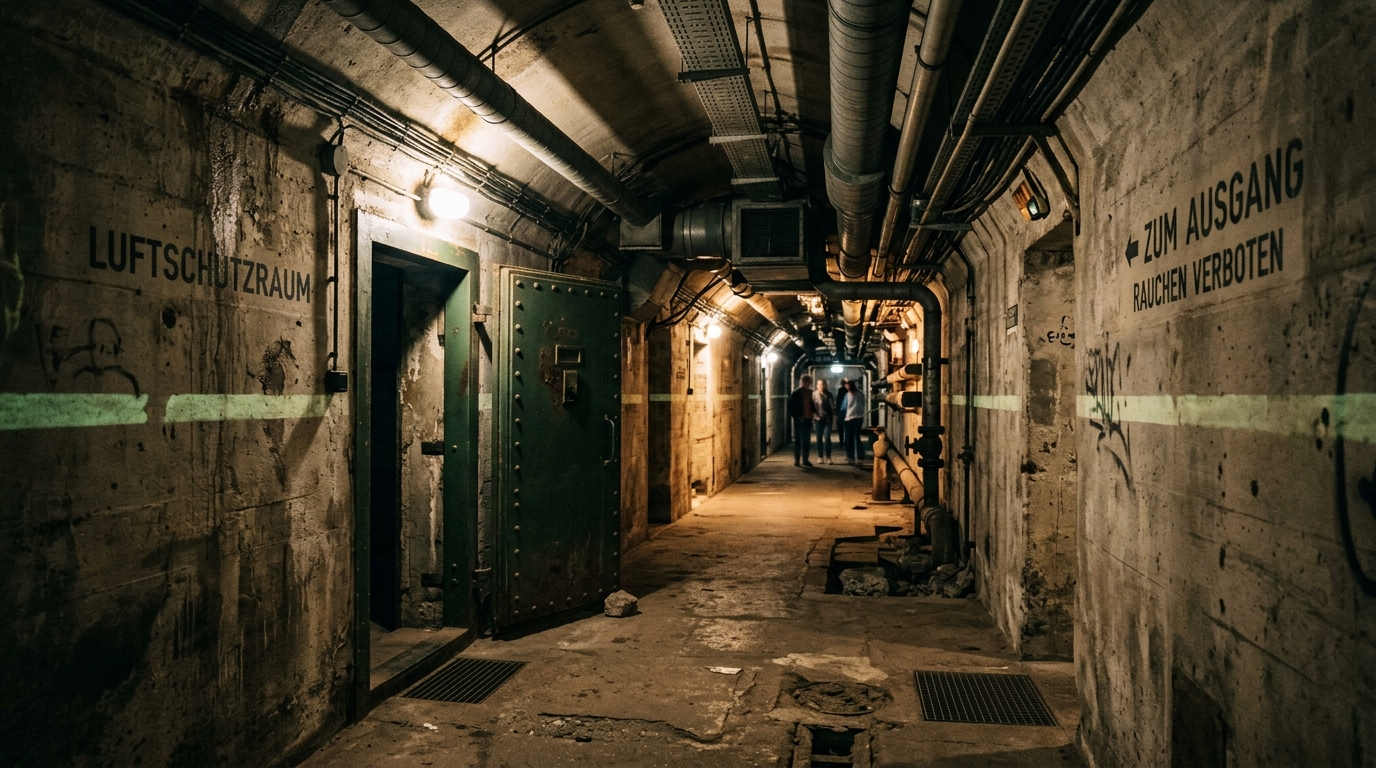
The Anatomy of the Gesundbrunnen Air-Raid Bunker
The complex beneath Gesundbrunnen was constructed between 1941 and 1942 as part of the Third Reich’s urgent Sofortprogramm (Immediate Air-Raid Shelter Program). As Allied bombing campaigns intensified following early RAF raids on Berlin in 1940, Nazi planners scrambled to convert subway infrastructure into civilian shelters.
At Gesundbrunnen, engineers adapted subterranean spaces originally excavated in the late 1920s as transit staff quarters, transformer rooms, and subway maintenance shafts. Spanning roughly 1,300 square meters across four underground levels, the shelter was officially rated to accommodate 1,200 people. In practice, during the devastating daylight raids of the Eighth Air Force and the nighttime firestorms of RAF Bomber Command in 1944 and 1945, between 5,000 and 6,000 desperate civilians crammed shoulder-to-shoulder into its claustrophobic concrete chambers.
Unlike the colossal, virtually indestructible Flak Towers in Humboldthain, Friedrichshain, and the Zoo—which featured two-to-three-meter-thick solid reinforced concrete walls—the Gesundbrunnen bunker was merely a reinforced civil defense shelter. Its ceiling concrete was less than one meter thick. It could protect against shell splinters, falling building debris, and shockwaves, but a direct hit from a 1,000-pound high-explosive bomb would have crushed it instantly.
Engineering for Survival: Luminescent Paint, Gas Locks, and Oxygen Starvation
Walking through the bunker today under the guidance of Berliner Unterwelten historians reveals the ingenious and chilling engineering required to keep thousands of panicked people alive beneath a collapsing city:
- Phosphorescent Guidance Paint (Leuchtfarbe): Power grids in Berlin invariably failed within minutes of an air attack. To prevent blinding panic when electric bulbs shattered, painters coated wall dado stripes, door frames, and exit signs with radioactive zinc sulfide paint. When tour docents switch off modern electric spotlights, these 80-year-old stripes still glow with an otherworldly greenish radiance, guiding the eyes down narrow passageways.
- Gas Locks & Hermetic Blast Doors: Remembering the horrors of mustard and chlorine gas warfare in World War I, authorities feared chemical bombing. Every entry point is guarded by double airlock chambers fitted with heavy, rubber-gasketed steel doors capable of withstanding gas infiltration and external detonation overpressures.
- Manual Air Filtration (Schutzlüfter): If the bunker's electric generator died, civilians were assigned shifts at hand-cranked and bicycle-pedaled mechanical air filters. Forcing outside air through massive cylindrical canisters of activated charcoal, these pumps supplied fresh oxygen and prevented carbon dioxide asphyxiation—though during heavy firestorms, high outside temperatures and fire gas often rendered incoming air suffocatingly hot.
Berliner Unterwelten is not a self-guided walk-in exhibition; access is strictly via guided historical tours, and demand is intense. Tour tickets are released online precisely 30 days in advance and popular weekend English slots often sell out within hours. Dress warmly—underground temperatures stay around 8°C to 12°C (46°F to 54°F) year-round regardless of outside summer heat—and wear sturdy closed-toe shoes; open sandals and flip-flops are strictly banned for safety reasons.
Rediscovery and Historic Monument Protection
Following the fall of Berlin in May 1945, Allied demilitarization orders mandated the demolition or sealing of all military and civil air raid installations. Because the Gesundbrunnen bunker was structurally intertwined with active U-Bahn and S-Bahn transit tunnels, blowing it up with dynamite would have brought down the entire train station and collapsed overhead street intersections.
Instead, the authorities sealed the entrance doors with steel plates, buried them behind brick walls, and forgot about them. For over 50 years, the complex sat in dark suspended animation, gathering dust and groundwater.
In the late 1990s, the newly formed Berliner Unterwelten negotiated access with the Berlin transit authority (BVG) and municipal monument authorities. Volunteers shoveled out tons of post-war rubble, installed climate-control dehumidification systems, and cataloged thousands of historical artifacts found inside: gas masks, children’s helmets, enamel house number signs salvaged from firebombed neighborhoods, and wartime pharmaceutical bottles. In 1999, their preservation work was formally recognized when the Gesundbrunnen shelter was granted official protected monument status (Denkmalschutz).
Beyond WWII: Cold War Escape Tunnels and Nuclear Shelters
While Tour 1 ("Dark Worlds" / Dunkle Welten) at Gesundbrunnen explores civil air defense and wartime civilian life, the Berliner Unterwelten association’s research extends across Berlin's entire subterranean landscape:
- Cold War Escape Tunnels: The association investigated and documented the daring escape tunnels hand-dug beneath the Berlin Wall along Bernauer Straße by West Berlin students and East German refugees, including legendary "Tunnel 29" and "Tunnel 57".
- The Nuclear Fallout Shelters: Down the street at U-Bahnhof Pankstraße and Blochplatz, the association maintains multi-purpose civil defense bunkers upgraded during the height of the 1970s Cold War, designed to shield 3,339 people against nuclear radiation and chemical fallout for up to 14 days.
- The Pneumatic Postal Network (Rohrpost): Historic archives preserve remnants of Berlin's once-sprawling pneumatic tube dispatch system, which transported millions of sealed telegram capsules through subterranean copper and iron pipes at 30 miles per hour between post offices.
Actionable Logistics: Visiting Berliner Unterwelten
Practical advice for planning your descent into the Berlin underground:
- Ticket Sales & Reservations: Bookings must be made via the official Berliner Unterwelten booking system. Same-day walk-up tickets at the Gesundbrunnen ticket pavilion are extremely limited and not guaranteed.
- Meeting Point: Tour 1 meets at the Berliner Unterwelten pavilion located directly outside the southern exit of U-Bahnhof Gesundbrunnen (Brunnenstraße 105, 13355 Berlin).
- Transit Directions: Ride the U-Bahn line U8 or S-Bahn lines S1, S2, S25, S41, or S42 directly to Gesundbrunnen. The station is a major northern hub with easy regional connections.
- Accessibility & Age Restrictions: Due to historic steep stairwells, uneven concrete flooring, and emergency evacuation parameters, bunker tours are not wheelchair-accessible. Children under the age of 7 are not admitted to bunker tours.


Comments
Post a Comment