The Schwerbelastungskörper: Berlin's 12,000-Ton Monument to Megalomania
The Schwerbelastungskörper: Berlin's 12,000-Ton Monument to Megalomania
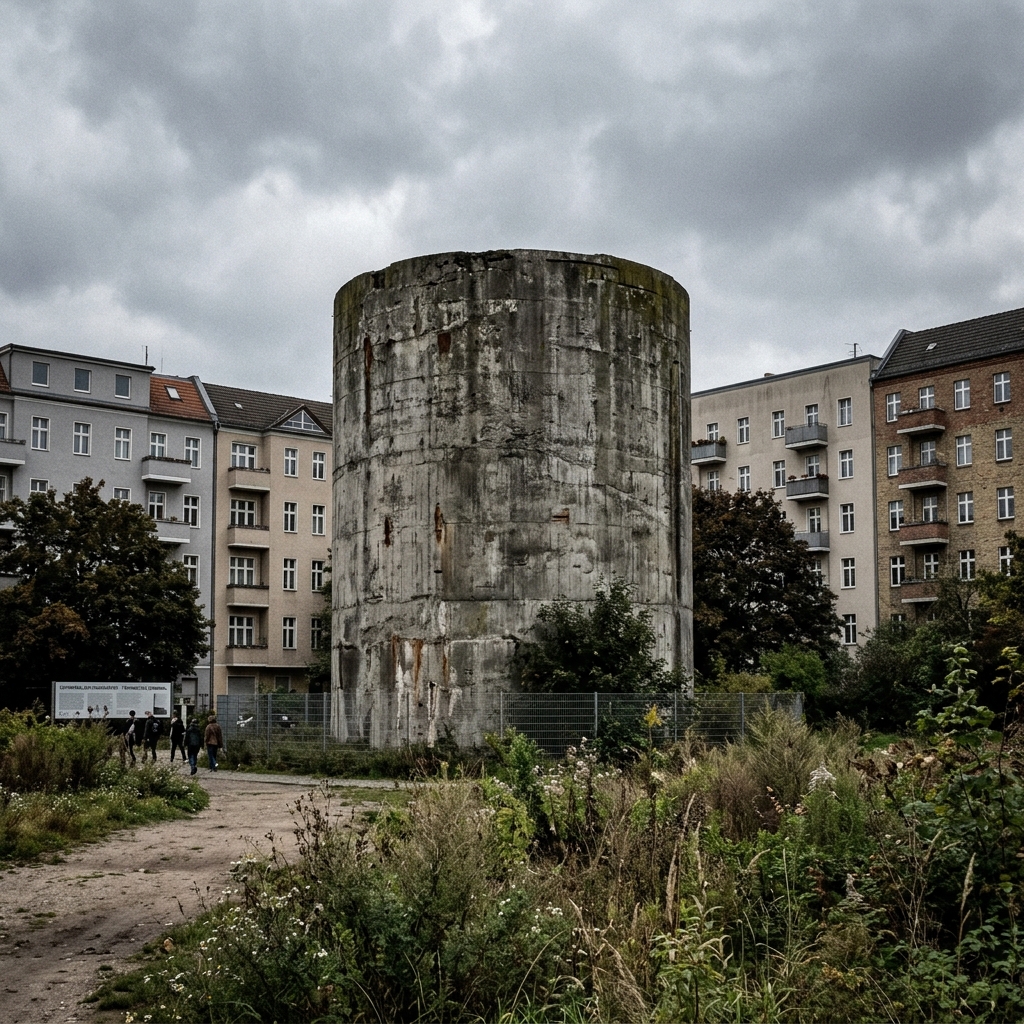
Berlin is a city scarred and shaped by grand visions that never quite materialized. Yet, tucked away in the neighborhood of Tempelhof, sits an undeniable, 12,650-ton physical reality. The Schwerbelastungskörper—literally the "Heavy Load-Bearing Body"—is a colossal concrete cylinder thrust into the sandy soil. It isn’t a bunker. It isn’t a fortress. It is a gigantic, megalomanic soil test.
Built between 1941 and 1942, this brutalist plug was designed by Albert Speer’s engineering corps to answer one simple question: Could Berlin’s marshy ground support the astronomical weight of Adolf Hitler’s "Welthauptstadt Germania"? The answer was a resounding, scientifically measured "no." Today, the cylinder survives as a chilling monument to fascist hubris, too massive to easily destroy, standing quietly amid residential streets.
The Delusion of Welthauptstadt Germania
To understand the Heavy Load-Bearing Body, you have to understand the sheer scale of what it was meant to precede. Hitler and his chief architect, Albert Speer, envisioned a complete overhaul of Berlin. The city was to be reborn as Germania, the capital of a thousand-year global empire.
The plans called for avenues wider than the Champs-Élysées and public buildings that would dwarf anything built in human history. Central to this vision was a monumental North-South Axis. At the intersection of this axis, Speer designed a Triumphal Arch. It was intended to celebrate German victories in World War I—a rather bitter irony—and was to stand 117 meters tall and 170 meters wide.
The Parisian Complex
The arch was explicitly designed to humiliate the Arc de Triomphe in Paris. Speer wanted a structure so gargantuan that the French monument could comfortably fit within its central opening. But building a skyscraper-sized solid stone arch presents a severe engineering problem, especially in Berlin.
Berlin is famously built on a swamp. The city's name likely derives from the old Slavic word "brlo," meaning swamp or wetland. The ground is a loose mix of sand, gravel, and high groundwater. If you plop a gargantuan stone arch onto loose sand, it will inevitably sink.
A 12,000-Ton Concrete Cylinder
Speer’s engineers weren't entirely foolish when it came to physics. They knew they needed empirical data. They had to simulate the immense ground pressure that one of the Triumphal Arch's pillars would exert. Thus, they commissioned the Schwerbelastungskörper.
French prisoners of war were forced into labor to construct the test block. The dimensions are staggering. The visible part of the cylinder is 21 meters in diameter and stands 14 meters above ground. But that is only half the story. The foundation reaches nearly 18 meters deep into the earth. It is a solid, unyielding mass of reinforced concrete weighing roughly 12,650 metric tons.
The Science of Sinking
Inside the cylinder and the surrounding earth, engineers installed highly sensitive measurement instruments, including French dials and gauges. The premise was simple: drop the heaviest thing you can build onto the sand, and measure how far it sinks over time.
The acceptable limit for the settling of the planned arch was six centimeters. Any more than that, and the monumental stone structure would crack, lean, or collapse under its own asymmetric weight.
Did the Ground Hold?
The testing began in 1941, but history had other plans. The war dragged on, turning the tide against the Third Reich. Resources for grand architectural experiments dried up, and Speer's focus shifted to war production and bunkers. Yet, the heavy load-bearing body continued to do its job: it pressed down on the earth.
The results were eventually tabulated. The concrete cylinder sank. It didn't just sink a little; it sank 18 centimeters over three years. That was three times the maximum permissible limit. The sandy, marshy Berlin underground had definitively rejected the Triumphal Arch.
Had Speer somehow managed to build the arch, it would have been a catastrophic structural failure. Welthauptstadt Germania was not only strategically and economically impossible; it was geologically doomed.
The Post-War Fate of the Heavy Load-Bearing Body
When the war ended, Berlin was a landscape of rubble. Almost everything related to Germania had been bombed to dust or remained merely as blueprints. But the Schwerbelastungskörper was stubbornly physical. It was entirely solid concrete, heavily reinforced.
In the immediate post-war years, there were discussions about demolishing it. However, the structure is located remarkably close to residential buildings in Tempelhof. The amount of explosives required to shatter a solid 12,000-ton block of concrete would have leveled the surrounding streets and shattered windows for miles.
So, it stayed. For decades, it was largely ignored, overgrown with weeds, a weird urban anomaly that locals walked past. It wasn't until 1995 that the site was officially placed under monument protection.
A Modern Memorial and Learning Site
Today, the Heavy Load-Bearing Body is an open-air museum and a registered historical monument. A viewing platform has been constructed nearby, allowing visitors to look down upon the massive cylinder and comprehend its scale.
It serves as a stark, unromanticized counterpoint to the grandiose rhetoric of the Nazi regime. There are no soaring eagles or neoclassical columns here—just a brutal, ugly plug of concrete that proved the absurdity of Hitler's vision.
For long-term Berliners, it is a reminder of the city's complex relationship with its own foundations. The city is built on unstable ground, both literally and metaphorically. The Schwerbelastungskörper stands as a testament to what happens when you try to force an impossible architecture onto a reality that simply won't bear the weight.
Actionable Takeaway: Visit the Monument
If you're exploring Tempelhof, take a short detour to witness this bizarre piece of engineering history. It’s a sobering, quiet site that offers more insight into the physical reality of Nazi plans than any blueprint ever could. The site is periodically open for public tours, and the viewing pavilion provides excellent historical context.
Heavy Load-Bearing Body
General-Pape-Straße 34A, 12101 Berlin, Germany
View on Google Maps ↗


Comments
Post a Comment