The Teufelsberg Listening Station: Berlin's Eerie Cold War Relic
The Teufelsberg Listening Station: Berlin's Eerie Cold War Relic
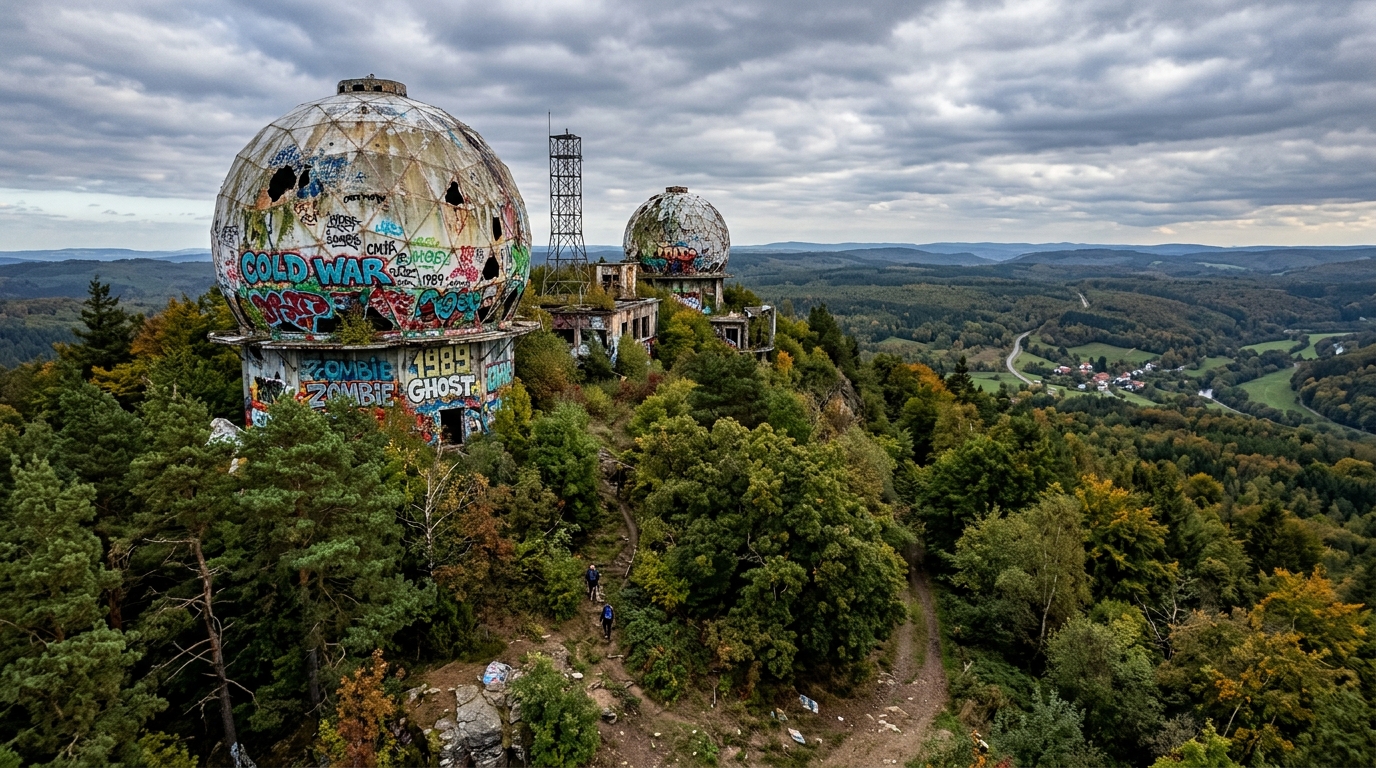
Rising incongruously from the dense canopy of the Grunewald forest on the western edge of Berlin is one of the most surreal and historically potent landmarks in Europe. Crowned by five massive, tattered white radar domes that look like something out of a retro sci-fi movie, Teufelsberg—literally "Devil's Mountain"—is a monument to the paranoia and high-stakes espionage of the Cold War. Today, it stands as an apocalyptic, graffiti-covered ruin, but for decades, it was one of the most sensitive and highly classified military installations in the world.
A Mountain Built from the Ashes of War
The history of Teufelsberg is literally built upon the ruins of World War II. The hill itself is entirely man-made. Following the devastating bombing campaigns that leveled much of the city, the monumental task of clearing the rubble fell largely to the *Trümmerfrauen* (rubble women). An astonishing 25 to 75 million cubic meters of debris from destroyed buildings were hauled to the Grunewald forest and piled high. This massive undertaking successfully buried the heavily fortified remains of a Nazi military-technical college that Hitler had commissioned as part of his grandiose "Germania" project.
By the time the dumping ceased, the artificial hill had reached an elevation of roughly 120 meters above sea level, making it the highest vantage point in West Berlin. In the politically tense, physically divided city of the 1950s, this sudden elevation presented an incredible strategic opportunity for the Western Allies.
The NSA and the ECHELON Network
Recognizing the unmatched line of sight over the Berlin Wall and deep into East German territory, the United States military, spearheaded by the National Security Agency (NSA), quickly established a listening post on the summit. Officially known as "Field Station Berlin," Teufelsberg became a critical node in the global ECHELON espionage network.
Operating around the clock, roughly 2,000 soldiers and intelligence personnel worked inside the iconic, weather-shielding radomes. Their mission was to monitor, intercept, and jam a vast array of communications from the Eastern Bloc. Using highly sophisticated surveillance arrays, they intercepted satellite phone calls, military radio transmissions, and faxes, listening in on Soviet and East German operations as far away as Moscow. The British Armed Forces also maintained a presence at the site, operating their own antenna towers. For decades, Teufelsberg was the very heart of the Western intelligence apparatus in divided Europe.
From Top Secret Base to Street Art Canvas
Following the fall of the Berlin Wall in 1989 and the subsequent end of the Cold War, the station's strategic value evaporated. The facility was decommissioned and officially abandoned by the Americans in the early 1990s. While various ambitious redevelopment plans for luxury hotels and apartments were proposed over the years, none ever materialized. The massive site was left to the elements.
In the absence of military guards, Teufelsberg was reclaimed by nature and Berlin's vibrant underground culture. The immense radomes and labyrinthine administrative buildings were transformed into one of the largest open-air street art galleries in the world. Every square inch of the decaying concrete is now covered in colorful, shifting murals and graffiti tags, creating a striking juxtaposition against the stark Cold War architecture.
Actionable Takeaways for Your Visit
Address: Teufelsseechaussee 10, 14193 Berlin, Germany
Today, Teufelsberg is managed by a private organization and is legally accessible to the public for an entrance fee. Visitors can explore the grounds, admire the world-class street art, and even climb into the highest radome—famous for its bizarre, echoing acoustics. Guided tours are highly recommended, as they offer fascinating insights into the daily lives of the spies who once worked there. It is a steep walk up through the forest to reach the summit, but the panoramic views of the Berlin skyline and the tangible sense of history make it an absolute must-do for any urban explorer.


Comments
Post a Comment