The Architectural Gravity of Karl-Marx-Allee
The Architectural Gravity of Karl-Marx-Allee: From Worker Palaces to Plattenbau
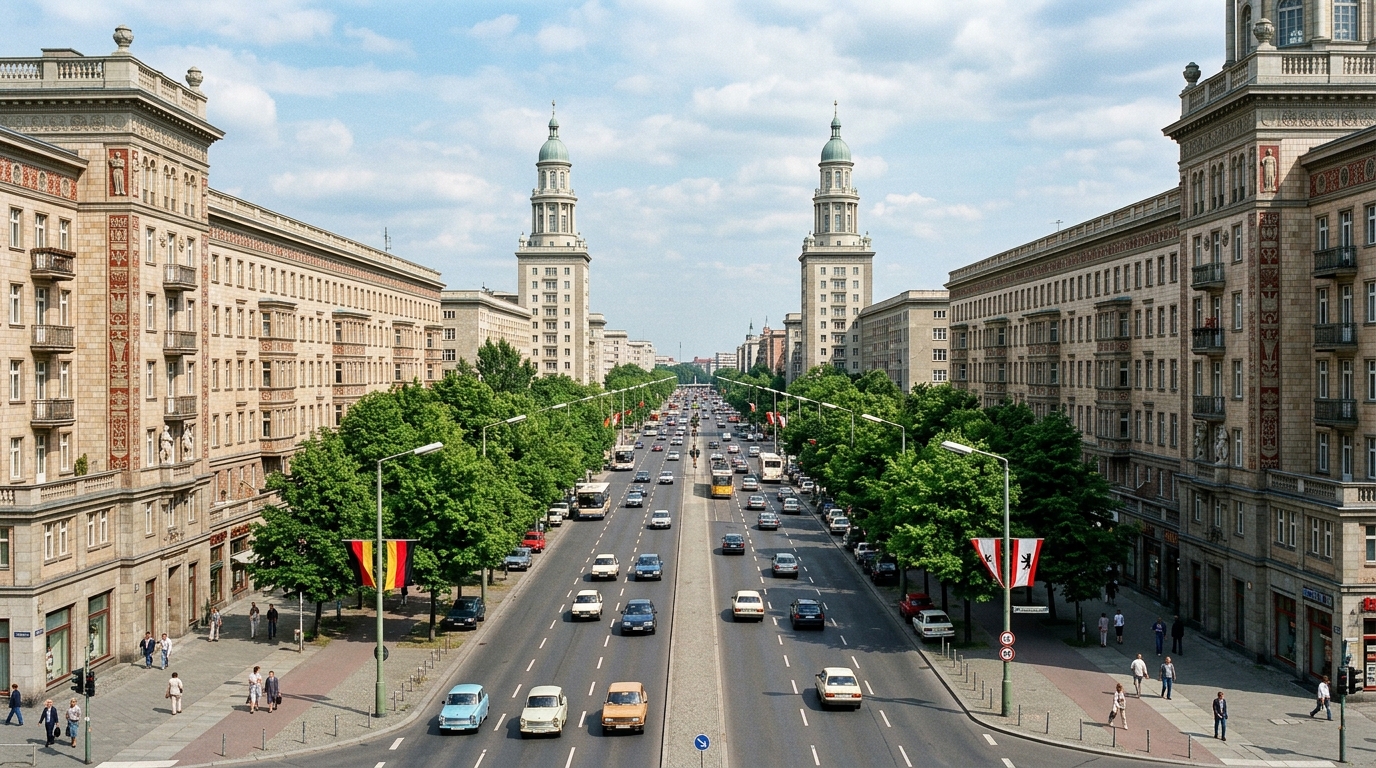
If you truly want to understand the stark, competing urban visions of the Cold War era, you must take a walk down Karl-Marx-Allee. Spanning the Friedrichshain and Mitte districts of Berlin, this monumental 90-meter-wide boulevard is much more than just a major thoroughfare. It is a massive, living testament to the political ambitions, aesthetic ideologies, and shifting economic realities of the former German Democratic Republic (GDR). Walking its length is like reading a history book written entirely in concrete, ceramic tiles, and urban planning.
"Palaces for the Workers" and Socialist Classicism
Following the utter devastation of World War II, the landscape of what was formerly Große Frankfurter Straße lay in ruins. The GDR government seized the opportunity to initiate a grand reconstruction project that would address the severe housing shortage while simultaneously demonstrating the purported superiority of the socialist system over the capitalist West. The street was initially renamed "Stalinallee" in 1949 in honor of Josef Stalin’s 70th birthday.
The eastern section of the boulevard, built in the early 1950s, was designed under the stylistic banner of "Socialist Classicism." Often derisively referred to as the "Wedding Cake style" (Zuckerbäckerstil) by its critics, this architecture was intended to provide literal palaces for the working class. Guided by prominent architects like Hermann Henselmann—who designed the prototypical Hochhaus an der Weberwiese and the iconic twin towers at Frankfurter Tor—the buildings featured monumental, neoclassical facades adorned with columns, turrets, and intricate ceramic tiles. Inside, the apartments were exceptionally luxurious for the era, boasting central heating, elevators, parquet floors, and high stucco ceilings. Beyond housing, the sheer width of the boulevard served a highly political purpose: it was designed as a grand stage for massive military parades and state-sponsored demonstrations.
The Shift to Modernism and Plattenbau
History, however, rarely stands still. Following the death of Stalin and the subsequent "de-Stalinization" process, the ideological and architectural winds shifted dramatically. The boulevard was officially renamed Karl-Marx-Allee in 1961. Simultaneously, the state realized that the ornate, handcrafted construction methods of the 1950s were simply too slow and far too expensive to solve the ongoing housing crisis.
As construction moved westward toward Alexanderplatz in the late 1950s and 1960s, the architectural style transitioned into a functional, highly industrialized phase. This era embraced the "Plattenbau" technique—the use of large, prefabricated concrete slabs. This "Second Modernism" of the GDR favored clean, stark lines over decorative classicism. The result is a fascinating visual timeline: start at one end of the street and you are surrounded by ornate wedding-cake palaces; walk a mile down, and you are immersed in austere, utilitarian modernism. This later section also introduced significant cultural and social structures, including the renowned Kino International cinema and Café Moskau, which remain defining icons of mid-century East German social life.
Actionable Takeaways for Architecture Enthusiasts
Address: Karl-Marx-Allee, 10 Berlin, Germany
Today, the entire ensemble of Karl-Marx-Allee is a protected heritage site. It is an absolute must-visit for anyone interested in architecture, history, or urban design. We highly recommend starting your walking tour at Frankfurter Tor and heading west toward Alexanderplatz to literally trace the evolution of GDR architecture. Take the time to admire the intricate tile work of the early 50s buildings before experiencing the sharp, modernist contrast of the 60s Plattenbau. It is an unforgettable journey through the complex heart of divided Berlin.


Comments
Post a Comment